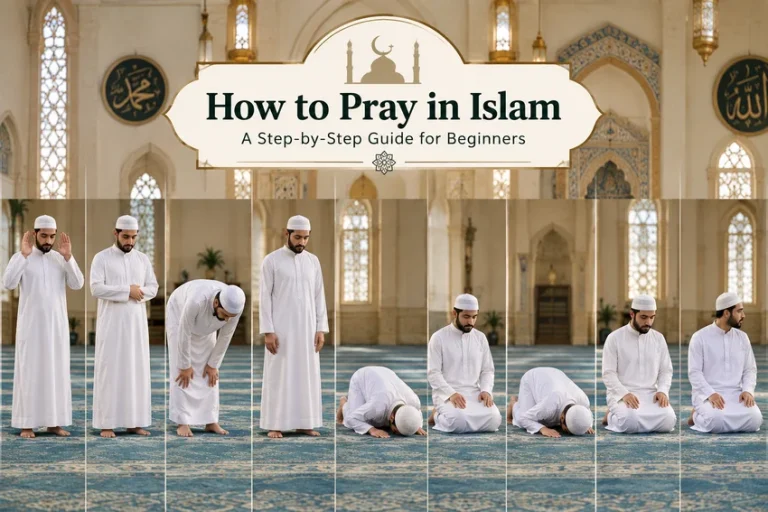
Muslim women perform the same five obligatory daily prayers as Muslim men: Fajr, Dhuhr, Asr, Maghrib, and Isha. The fundamental acts of Salah—such as standing, Quran recitation, Ruku, Sujood, Tashahhud, and Salam—remain part of the prayer.
However, women commonly have questions about prayer clothing, Awrah, posture, praying in congregation, Friday prayer, and other circumstances.
This guide focuses on those women-specific aspects of Salah.
Is Salah Different for Women?
The fundamental structure of Salah is the same. A woman observes the required preparation, faces the Qiblah, makes Niyyah, performs the prayer movements, recites the required portions, and completes the prayer with Salam.
Some details of women’s prayer posture and related rulings differ among recognized schools of Islamic jurisprudence.
This means you may see different instructions about how women position their hands, arms, legs, or body during certain parts of Salah. Such differences should not automatically be treated as mistakes.
For school-specific guidance, follow a qualified Islamic teacher or scholar. At Al Minhaal Academy, students can learn about Salah and other aspects of Islamic practice with guidance from knowledgeable teachers.
What Should a Woman Wear for Salah?
One of the most important considerations for women is appropriate prayer clothing.
A woman should wear clothing that fulfills the Islamic requirements for covering her Awrah during Salah.
Prayer clothing should generally be:
- Modest
- Sufficiently covering
- Clean
- Suitable for performing the movements of Salah
- Appropriate according to the Islamic rulings followed by the woman
Does a Woman Need a Hijab for Prayer?
A woman should observe the required covering during Salah. The exact details of what must be covered can differ according to recognized schools of Islamic jurisprudence.
Many women therefore use a dedicated prayer garment or prayer outfit that provides appropriate coverage.
How Should a Woman Prepare for Salah?
Before praying, a woman should make sure the basic requirements of Salah are fulfilled.
Wudu
Perform Wudu when ritual purification is required.
Cleanliness
Ensure that the body, clothing, and prayer place meet the requirements of cleanliness.
Awrah
Wear clothing that fulfills the requirements for covering the Awrah.
Prayer Time
Make sure the prescribed time for the prayer has entered.
Qiblah
Face the Qiblah, the direction of the Ka’bah in Makkah.
Niyyah
Make the intention in your heart for the particular prayer you are going to perform.
What Is the Female Position of Namaz?
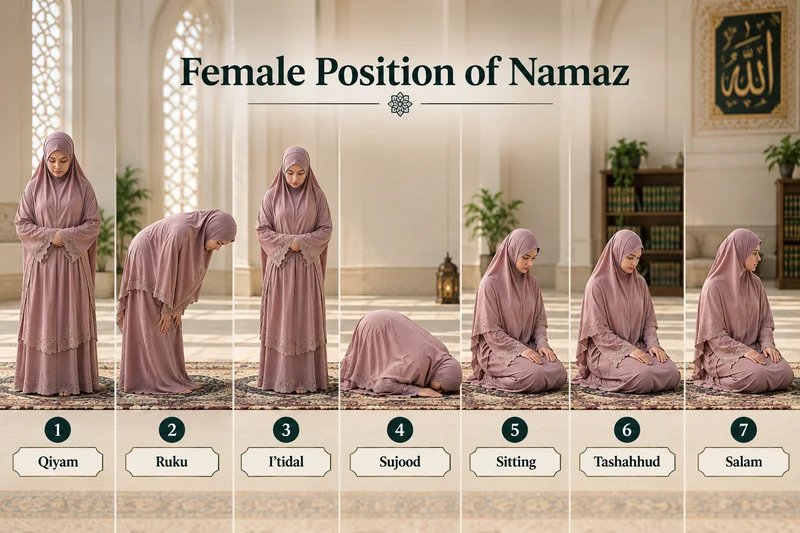
Women perform the same essential prayer positions, including:
- Qiyam — standing
- Ruku — bowing
- I’tidal — standing after Ruku
- Sujood/Sajdah — prostration
- Sitting
- Tashahhud — sitting for the testimony
- Salam — completing the prayer
The specific posture used by women can differ according to the school of Islamic jurisprudence being followed.
For example, you may encounter different instructions regarding how closely the limbs are held to the body during Ruku or Sujood.
Rather than mixing different methods from different sources, a woman should learn the prayer posture from a reliable teacher who can explain the practice followed in her school.
How Does a Woman Perform Sajdah?
Sajdah (Sujood) is the prostration performed during Salah.
A woman performs Sujood as part of the normal prayer sequence. During prostration, one of the commonly recited phrases is:
Subhana Rabbiyal A’la
Glory be to my Lord, the Most High.
The exact physical details of women’s Sajdah can differ among recognized schools of jurisprudence.
If you are learning Salah for the first time, focus first on learning the correct sequence and essential recitations, then learn the posture according to the practice you follow.
Are Women’s Prayer Positions Different From Men’s?
This is an area where Muslims may encounter different opinions.
The essential components of Salah remain the same, but some scholars and schools have prescribed or recommended different physical positions for women in certain parts of prayer.
These differences may concern:
- Hand placement
- Ruku posture
- Sujood posture
- Sitting position
- How closely the limbs are positioned
Because these are matters of Islamic jurisprudence, it is better to follow one reliable method rather than combining different rulings from unrelated sources.
Can Women Pray in Congregation?
Women can participate in Jama’ah (congregational prayer).
Women may pray in a mosque or another suitable place of congregation while observing the applicable Islamic guidelines.
In congregational prayer, women may pray behind the Imam with the other worshippers. The arrangement of prayer rows and other details can vary according to the circumstances and school of jurisprudence.
Can a Woman Lead Prayer in Islam?
The ruling concerning a woman leading Salah depends on who is being led and the jurisprudential school being followed.
Because this question involves specific fiqh rulings, it should not be answered with a single rule that applies to every situation.
If you have a particular situation—for example, leading other women or leading a mixed congregation—consult a qualified Islamic scholar.
Can a Woman Pray in Front of a Man?
A woman may have questions about praying when men are present, particularly in shared homes, workplaces, public spaces, or other environments.
Simply being visible to a man does not make every prayer situation the same. The relevant circumstances can include:
- Whether the man is a Mahram or non-Mahram
- Whether the people are praying individually or in congregation
- The prayer space and arrangement
- Requirements concerning modesty and privacy
For a specific situation, seek guidance from a qualified scholar according to the school of jurisprudence you follow.
Can a Woman Pray in Front of a Non-Mahram?
Questions about praying around a non-Mahram should be considered separately from questions about prayer itself.
A woman should maintain the required Islamic covering and observe the applicable rules concerning privacy and interaction with non-Mahram men.
If you are unsure about a particular situation, ask a qualified Islamic teacher or scholar rather than relying on a general online answer.
Can Women Pray in Public?
Sometimes a woman may need to pray while away from home.
When praying in a public place, she should look for a suitable location where she can:
- Pray within the correct time
- Maintain the required covering
- Use a clean prayer space
- Face the Qiblah where reasonably possible
- Perform Salah properly
A private or designated prayer space can make it easier to maintain the requirements of Salah.
Can Women Pray Friday Prayer?
Jumu’ah, or Friday prayer, is a congregational prayer held on Friday.
Women may attend Jumu’ah at a mosque. The detailed rulings concerning whether Jumu’ah is obligatory for women and its specific conditions should be understood according to recognized Islamic jurisprudence.
Women who do not attend Jumu’ah should follow the applicable ruling concerning the regular Dhuhr prayer.
For a specific question about Jumu’ah, consult a qualified scholar.
How Does Pregnancy Affect a Woman’s Salah?
Pregnancy does not by itself mean that a woman stops performing Salah.
However, pregnancy may make standing, Ruku, Sujood, or other movements physically difficult.
When a woman is unable to perform a particular prayer position normally because of a genuine physical difficulty, there are established rulings concerning how Salah can be performed according to her ability.
What About Salah During Menstruation?
Menstruation is an important topic when discussing women’s Salah.
Women do not perform the regular obligatory Salah during menstruation, and the detailed rulings concerning purification and resuming prayer should be learned from a qualified Islamic teacher or scholar.
This is a separate area of Islamic jurisprudence and should not be confused with ordinary prayer difficulties.
How Many Rak’ahs Do Women Pray?
Women perform the same number of obligatory Rak’ahs as men:
| Prayer | Obligatory Rak’ahs |
|---|---|
| Fajr | 2 |
| Dhuhr | 4 |
| Asr | 4 |
| Maghrib | 3 |
| Isha | 4 |
Additional Sunnah prayers and Witr are separate from the obligatory Rak’ahs.
Learn Salah With Confidence
Learning how to pray in Islam for women becomes easier when you separate the fundamentals of Salah from the areas where schools of Islamic jurisprudence have different opinions.
Start by learning the basic prayer sequence, essential recitations, Wudu, and the requirements of Salah. Then learn the women-specific prayer posture and rulings from a reliable Islamic teacher or scholar.