For many children, age 3 or 4 is a suitable time to begin preschool. By this stage, children are often developing stronger language skills, greater independence, and more interest in interacting with other children.
However, there is no single perfect preschool starting age.
A child may be ready when they can:
- Communicate basic needs
- Spend some time away from parents or caregivers
- Follow simple instructions
- Participate in basic routines
- Interact with other children
- Attempt age-appropriate tasks independently
Parents should consider age and developmental readiness together rather than choosing preschool based only on age.
What Age Do Children Start Preschool in the USA?
Preschool in the United States generally serves children during the years before kindergarten, commonly around ages 3 and 4.
However, preschool admission requirements are not identical across the country. Age cutoffs and eligibility can vary by state, school, program, and type of preschool.
Parents should therefore check the enrollment requirements of the preschool they are considering instead of assuming that one age rule applies everywhere.
How Do You Know If Your Child Is Ready for Preschool?
Preschool readiness includes social, emotional, communication, and practical skills. A child does not need to master everything before starting, but certain signs can help parents assess readiness.
Communication Skills
Your child should be developing ways to communicate basic needs, such as asking for help, expressing discomfort, or telling an adult what they want.
Perfect speech is not a requirement.
Social Readiness
Preschool gives children opportunities to interact with teachers and other children.
Readiness may include an emerging ability to:
- Play alongside or with other children
- Take turns
- Share with guidance
- Participate in group activities
- Respond to adults outside the immediate family
These skills continue developing during preschool itself.
Emotional Readiness
Consider how your child handles separation from you and responds to unfamiliar people or environments.
Some separation anxiety is normal. The important question is whether the child can gradually adjust to being cared for and taught by trusted adults.
Following Simple Instructions
Preschool classrooms involve routines such as sitting for an activity, putting items away, washing hands, transitioning between activities, and listening to simple directions.
A child’s growing ability to participate in these routines can indicate readiness.
Growing Independence
Age-appropriate independence can include attempting to eat, wash hands, manage belongings, tidy up, or complete other simple tasks.
Preschool should continue developing these abilities rather than expecting complete independence from the beginning.
Is 2 Years Old Too Early for Preschool?
Not necessarily. Some early childhood programs accept children around age two, but suitability depends heavily on the individual child and program.
Parents should consider:
- Separation readiness
- Communication ability
- Daily schedule
- Length of attendance
- Classroom environment
- Teacher support
- The child’s developmental needs
A nurturing, age-appropriate program for a two-year-old can look very different from a preschool classroom designed for four-year-olds.
Is 3 a Good Age to Start Preschool?
Age three is a common time for families to consider preschool.
At this age, many children are developing rapidly in areas such as language, social interaction, movement, imagination, and independence.
A quality preschool can provide opportunities to practice:
- Communicating with others
- Following routines
- Playing cooperatively
- Listening
- Problem-solving
- Early literacy and numeracy
- Independence
Whether a particular three-year-old is ready still depends on the child’s individual development.
What About Starting Preschool at Age 4?
Starting preschool at four can also provide valuable preparation for kindergarten and a more structured school environment.
Children can strengthen skills such as:
- Listening and communication
- Early literacy
- Early numeracy
- Fine and gross motor skills
- Social interaction
- Following classroom routines
- Independent learning habits
A child who did not begin preschool at age three should not automatically be considered behind. Children develop at different rates and enter early education through different pathways.
Preschool vs. Pre-K: What’s the Difference?
Preschool and pre-K are closely related, but they are not always identical.
Preschool generally refers to early childhood education before kindergarten and may include a broader range of preschool-age children.
Pre-K (pre-kindergarten) commonly serves children closer to kindergarten age and may place greater emphasis on school readiness.
The terminology varies among schools and programs, so parents should look at the actual curriculum, age requirements, and learning environment, not just the program name.
Preschool vs. Daycare: What’s the Difference?
The terms can overlap, but their primary purposes may differ.
Preschool generally emphasizes early learning and child development through structured and play-based activities.
Daycare or child care primarily provides care and supervision while parents or caregivers are unavailable, although many child care centers also offer educational activities.
When comparing options, consider the program’s teachers, curriculum, daily routine, environment, safety practices, and approach to child development.
What Should Muslim Parents Look for in a Preschool?
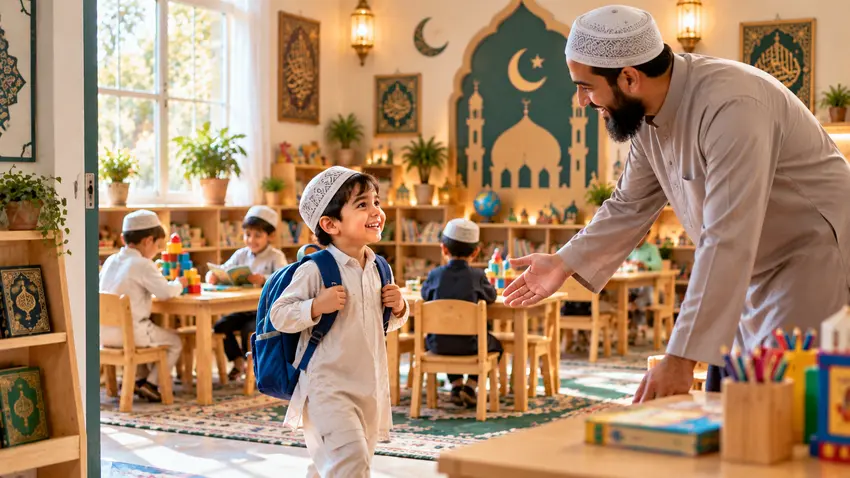
Muslim parents generally want the same fundamentals that every family should expect from a quality preschool: safety, caring teachers, age-appropriate learning, positive social development, and good communication with families.
They may also want an environment that supports their family’s Islamic values.
Consider whether a preschool provides:
- A safe and nurturing environment
- Qualified and caring teachers
- Age-appropriate learning
- Opportunities for play and creativity
- Positive social interaction
- Good communication with parents
- Respect for Islamic manners and values
- Age-appropriate Islamic learning
- A positive environment for developing Muslim identity
Academic development and Islamic character development do not need to compete with each other. A thoughtful early childhood program can support both.
Why Does Islamic Learning Matter During the Preschool Years?
The preschool years are an opportunity to establish positive habits and introduce children to their faith in an age-appropriate and encouraging way.
Islamic early childhood education can introduce simple concepts such as:
- Love and awareness of Allah
- Quran
- Simple duas
- Salah awareness
- Islamic greetings
- Gratitude
- Kindness
- Cleanliness
- Respect for parents and teachers
- Sharing and helping others
At this age, Islamic learning should not simply be about memorizing information. Children can learn through stories, repetition, play, daily routines, observation, and positive examples from adults.
Building Good Akhlaq From an Early Age
Akhlaq refers to character and manners.
Preschool provides many everyday opportunities for children to practice good character. Waiting for a turn can teach patience. Sharing can encourage generosity. Helping another child develops kindness and responsibility.
Parents and teachers can reinforce qualities such as:
- Honesty
- Kindness
- Respect
- Patience
- Gratitude
- Sharing
- Helping others
- Good manners
For Muslim children, connecting these everyday behaviors with Islamic values can help make faith part of daily life rather than something learned only as a separate subject.
Balancing Early Education With Islamic Values
A strong Islamic preschool experience can combine early childhood development with age-appropriate Islamic education.
General early learning may include:
- Language and communication
- Letters and early literacy
- Numbers and early numeracy
- Creativity
- Motor development
- Social skills
- Problem-solving
Islamic learning may introduce:
- Quran
- Simple duas
- Islamic stories
- Islamic manners
- Salah awareness
- Kindness and respect
- Muslim identity
The goal is not to overload young children with formal lessons. Early education should encourage curiosity, confidence, good character, and a positive relationship with learning and Islam.
How to Choose the Right Preschool for Your Child
The best preschool is not necessarily the one with the longest school day or the most advanced academic curriculum.
Look for a program that fits your child’s developmental needs and your family’s priorities.
Before enrolling, consider:
- Your child’s age and readiness
- Teacher qualifications and approach
- Class size and environment
- Curriculum
- Play and learning balance
- Safety and cleanliness
- Daily schedule
- Communication with parents
- School values
- Islamic environment, if important to your family
- Location and practical needs
When possible, visit the preschool, observe the environment, meet the teachers, and ask how the program handles learning, behavior, communication, and child development.
Preschool at Al Minhal Academy
For Muslim families looking for early education within an Islamic learning environment, Al Minhal Academy provides an opportunity for children to develop foundational skills while growing in an environment shaped by Islamic values.
Explore the Preschool Program at Al Minhal Academy to learn more about the program, learning environment, admissions, and enrollment.